Why I Switched from ChatGPT to Claude (And Why It Was Easier Than I Expected)
ChatGPT vs Claude: What Actually Matters
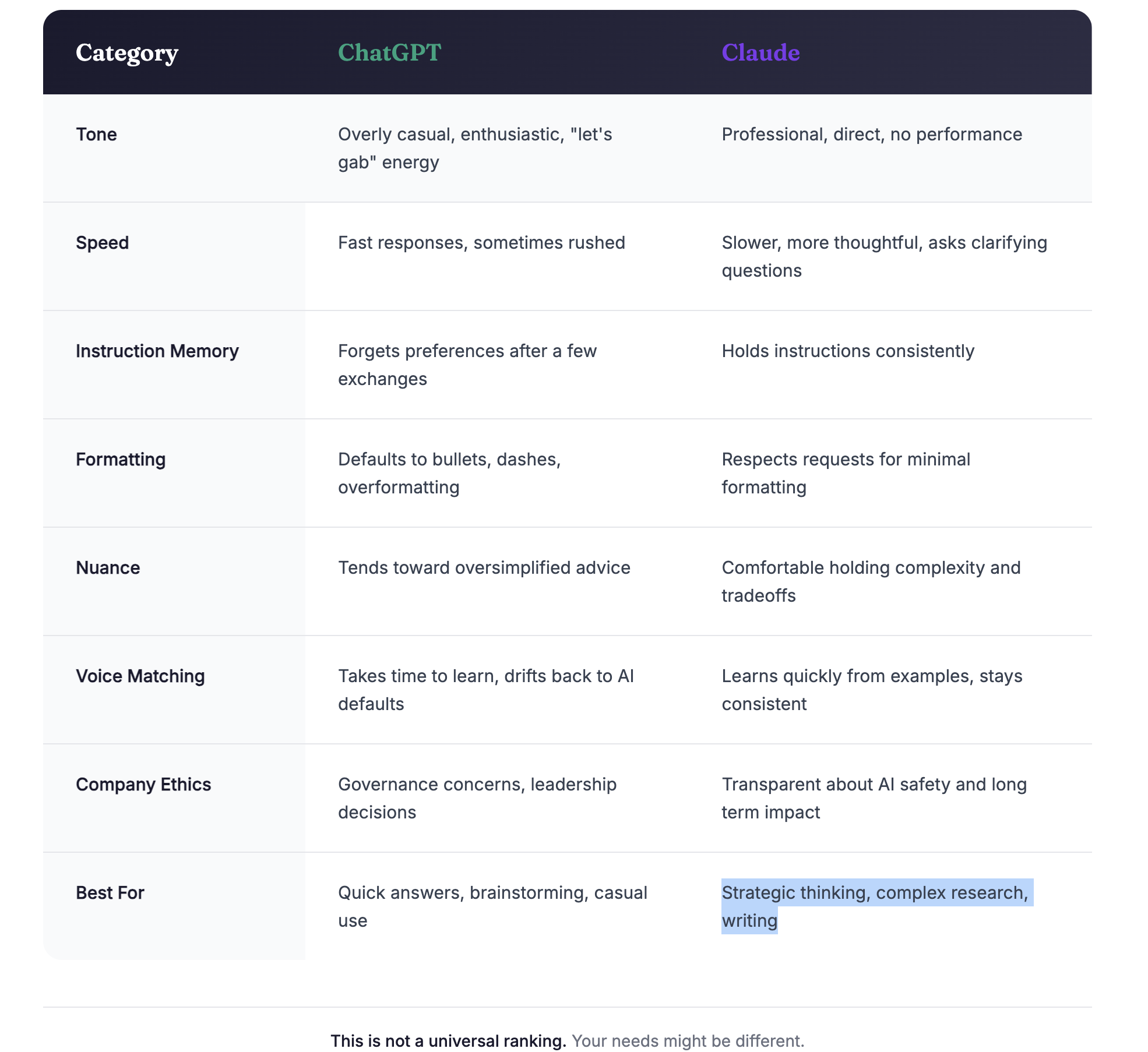
Here is what the comparison looked like for my use case.
I switched from ChatGPT to Claude a few weeks ago.
Not because of the super bowl ads. Not because of pricing. Not even because of feature differences.
I switched because of how the company is being run.
The Real Reason: Ethics Over Features
Tech companies eventually monetize. We all know this. I am not naive about how platforms make money, and I am not opposed to paying for tools that provide value.
But there is a difference between monetization and the way a company operates at its core.
Anthropic, the company behind Claude, has been far more transparent about their approach to AI safety, governance, and the long term impact of what they are building. That transparency matters to me.
So I made the switch.
What I Thought Would Be Hard
I expected migration to be a nightmare.
I had years of conversation history in ChatGPT. Saved searches. Workflows. Custom instructions I had refined over time. The idea of starting over felt overwhelming.
But here is what I learned.
Most of that history did not actually need to come with me.
Think about it this way. If you switched from Safari to Chrome, would you need to import every single thing you ever googled? No. Most of it was contextual to a moment in time and no longer relevant.
The same was true for my ChatGPT history.
I did not need old troubleshooting conversations. I did not need drafts from six months ago that I never used. I did not need half finished ideas that went nowhere.
What I actually needed was much smaller and much more intentional.
What Did Need to Transfer
There were a few things that mattered.
1. My preferences
I bake a lot. I weigh everything in grams because it is more precise. I hate when recipes give me volume measurements or switch between systems halfway through.
Small detail. Big quality of life improvement.
I needed Claude to understand that. And it took exactly one conversation to set it up.
2. My voice
I write a lot. Blog posts. LinkedIn updates. Internal documentation. Instagram captions.
ChatGPT had learned my tone over time. It knew when I wanted something sharp versus reflective. It understood my sentence structure, my rhythm, the way I think through problems.
I was worried Claude would not be able to match that without months of training.
But here is the thing. There is already a lot of my content out there. Blog posts. Articles. Public writing.
I gave Claude a few examples of my work, and it adapted quickly. Faster than I expected. Within a few interactions, it was writing in a way that sounded like me, not like generic AI content.
3. Context on ongoing projects
I had a few active projects in ChatGPT. A blog series on Traction. My personal Level 10 with my quarterly rocks. Website copy revisions. Sourdough baking recipes. Dream Journal.
I brought those over manually. Not by importing. Just by opening a new conversation in Claude and saying, "Here is what I am working on. Here is where I am stuck."
It picked up immediately.
What Actually Improved
Switching was not just neutral. Some things got better.
Claude does not pretend to be my friend.
This was the biggest relief.
ChatGPT had started adopting this overly casual, "oh hey girlfriend let's gab" personality that felt increasingly grating. Every response started with enthusiastic affirmation. Every suggestion came wrapped in exclamation points and encouragement I did not ask for.
I am not looking for a cheerleader. I am looking for a thinking partner.
Claude treats me like a professional. It is direct. It is helpful. It does not perform enthusiasm or try to build rapport through tone. It just does the work.
That matters more than I realized it would.
Claude is slower, and that is actually better.
ChatGPT optimizes for speed. It wants to give you an answer immediately, even if that answer is not fully thought through.
Claude takes longer. Not because it is less capable, but because it is doing more thinking before it responds.
For simple questions, this does not matter much. But for complex research assignments, strategic thinking, or anything that requires nuance, the extra time is worth it.
Claude asks clarifying questions when something is ambiguous instead of guessing. It considers multiple angles before landing on a recommendation. It does not rush to the answer.
I do not want a tool that just outputs fast. I want a tool that thinks with me.
Claude respects my intent.
When I say I do not want something formatted a certain way, it listens. When I ask for no dashes, no emojis, no unnecessary bullet points, it does not revert back to AI defaults two responses later.
ChatGPT would constantly slip back into its defaults. Bullet points everywhere. Dashes. Overformatting. Like it forgot what I asked for three exchanges ago.
Claude holds instructions. Small thing. But it compounds over time.
Claude handles nuance better.
I work in operations. I write about leadership. These are not black and white topics. There is context. There are tradeoffs.
Claude seems better at holding complexity without collapsing it into oversimplified advice. It can say, "This depends on whether you prioritize X or Y," instead of just giving me the most common answer.
That is the difference between a tool and a thinking partner.
Why Ethics Matter More Than Features
Here is the truth.
ChatGPT and Claude are both excellent tools. On a feature by feature comparison, they are close enough that most people would not notice a meaningful difference day to day.
So the deciding factor was not capability. It was values.
I care about how companies treat the technology they are building. I care about transparency. I care about whether leadership is making decisions that prioritize long term responsibility over short term growth.
Anthropic is not perfect. No company is. But their approach to AI safety, their willingness to publish research openly, and their commitment to building thoughtfully instead of recklessly aligned more closely with how I want to engage with this technology.
That was enough.
The Bottom Line
If you are thinking about switching from ChatGPT to Claude, or from any tool to another, here is what I would tell you.
You do not need to bring everything with you. You need to bring what matters.
And if the reason you are switching is not just features but values, that is a completely valid reason. In fact, it might be the best reason.
We vote with our attention. We vote with our subscriptions. We vote with which tools we choose to integrate into our daily thinking and creating.
I chose to vote for the company that is being more thoughtful about what they are building and why.
The switch was easy. And I have not looked back.
About Molly
Molly Means is a business operator who writes about Traction, operations, leadership, and organizational clarity. Her work is informed by experience building and operating companies and helping teams create structure that actually works.